Five years, from student to teacher
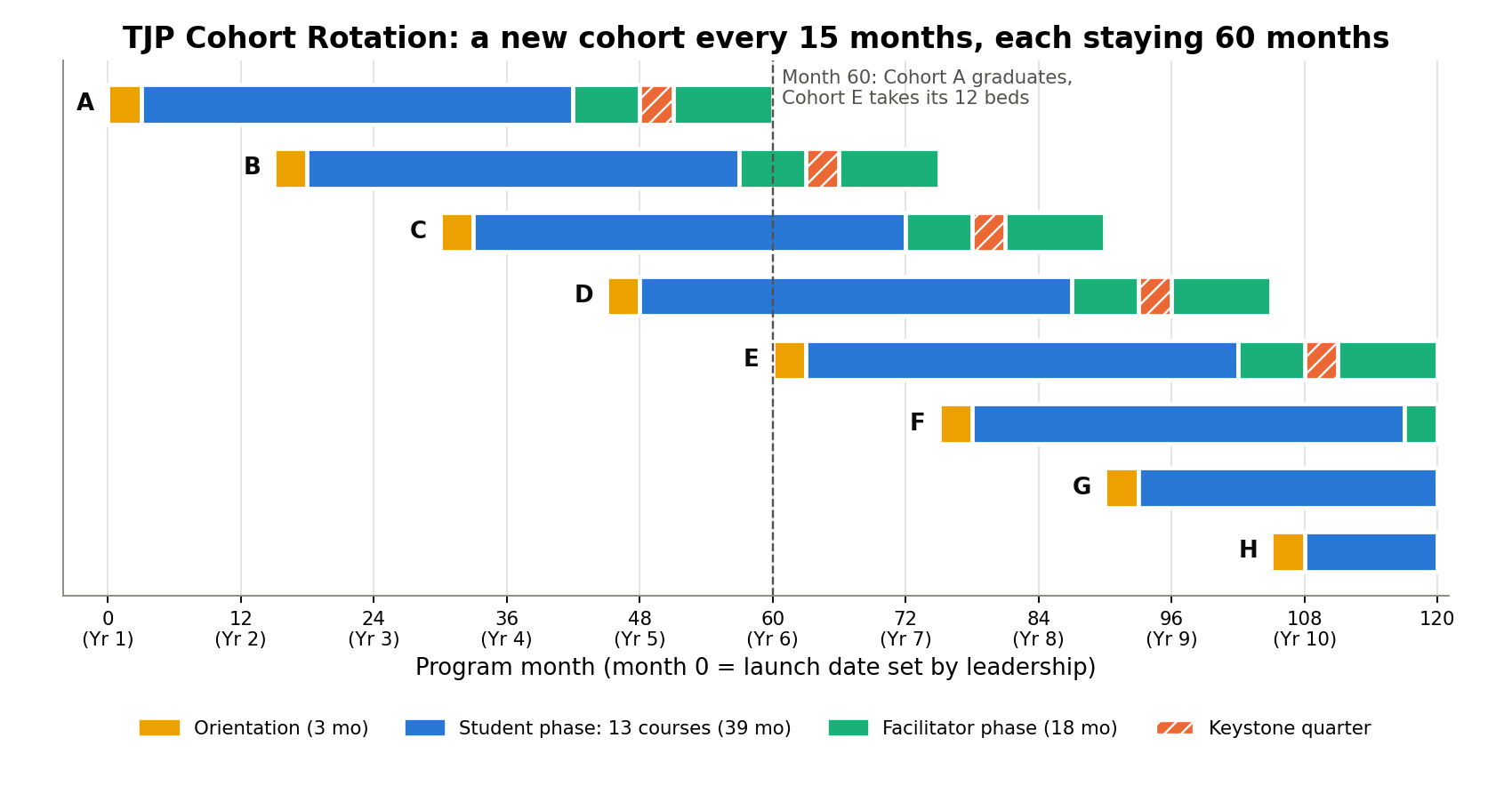
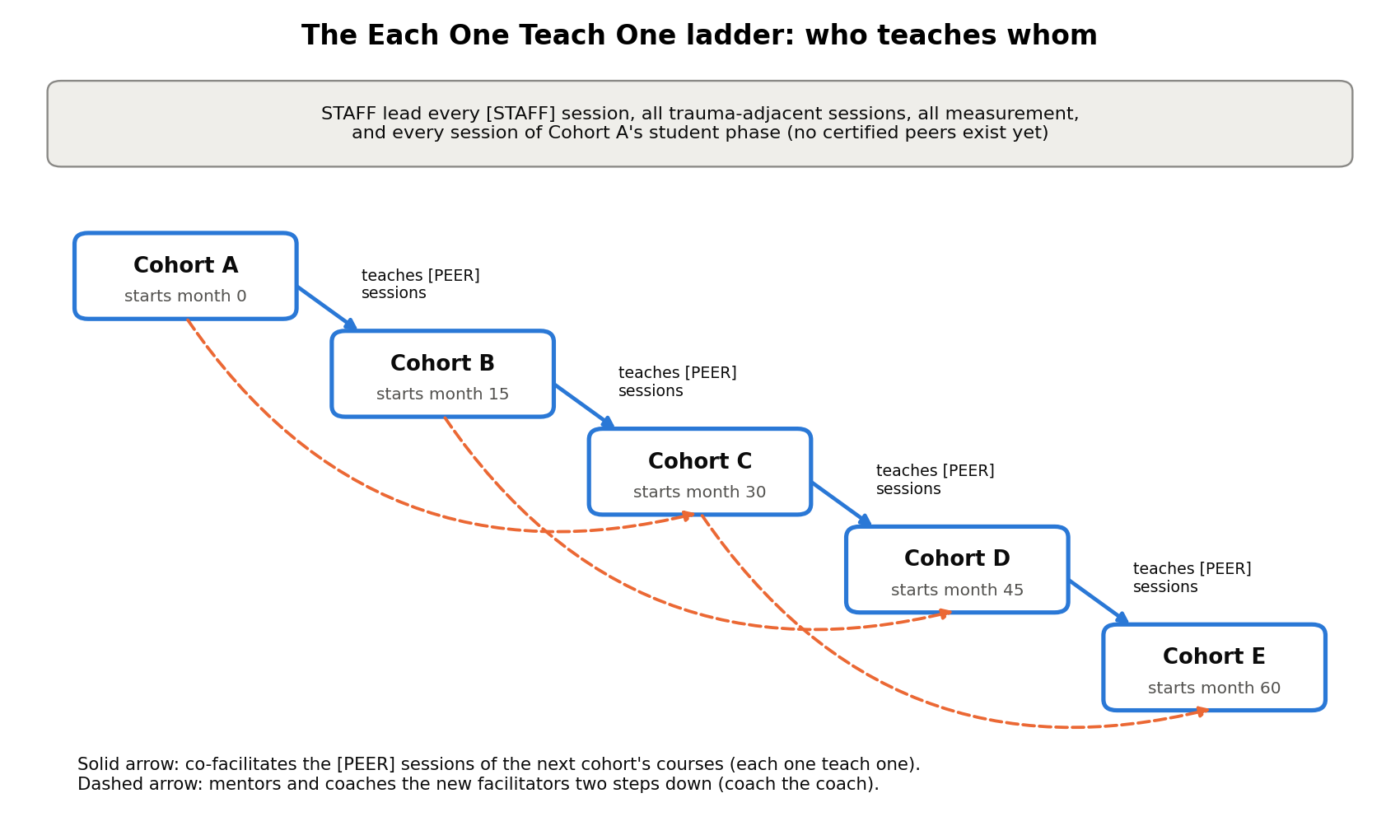
TJP grows the way a careful builder lays an arch: a few stones at a time, each one supported before the next goes on. Small cohorts of twelve start fifteen months apart, so each group can learn from the last and teach the next.
- Months 0 to 2
Orientation
Safety and consent come first. Residents write their Personal Narrative using the HEALING prompts, give baseline measures, sign the TRUST team charter, learn the Meeting Rhythm and the Playbook, and are matched with a senior resident as a mentor.
The Personal Narrative - Months 3 to 41
Student phase
All thirteen courses, one per quarter: ten weeks of course and three weeks of buffer for holidays, lockdowns, and make-ups. Each course ends with a product built and tested by the cohort.
The courses - Months 42 to 47
Teaching
Residents co-facilitate peer-led sessions for the cohort behind them, teach in other units, and form Keystone teams of three to five.
The facilitator workshop - Months 48 to 50
The Keystone
One real, bounded South Carolina harm. One full intervention a community could adopt, defended in front of an outside panel.
The Keystone - Months 51 to 59
Teaching and mentoring
Residents keep teaching, mentor newer residents, and see the six-month check on whether their Keystone was picked up outside the fence. Then the bed passes to the next cohort.
The Cohort Rotation Plan
The order courses are taught
The courses are modular, but every cohort follows the same order. The lowest-risk, fastest-results courses come first. Facilitator training comes fifth, so residents practice teaching for eight more courses. The clinical block waits until licensed staff are confirmed.
- 1
Acts of Violence Are Failed Requests
Course 11 | Nonviolent Communication
Quarter 2 - 2
Identity Is a Vote
Course 9 | Developing Values-Based Atomic Habits
Quarter 3 - 3
Constructing a Changed Mind
Course 1 | Interpersonal Neurobiology
Quarter 4 - 4
The Science of Safety
Course 3 | Polyvagal Theory
Quarter 5 - 5
No One Educates Alone
Course 13 | Critical Pedagogy and the Credible Messenger
Quarter 6 - 6
The Attention You Own
Course 7 | Therapeutic Mindfulness
Quarter 7 - 7
Redemptive Compassion
Course 10 | The Age of Empathy
Quarter 8 - 8
The Unmaking of a Criminal
Course 2 | Criminogenics and Restorative Justice
Quarter 9 - 9
Trauma and the Brain
Course 4 | Trauma and the Brain
Quarter 10 - 10
The Unfinished Response
Course 5 | Somatic Practices
Quarter 11 - 11
The Engine of Violence
Course 6 | Shame Resilience
Quarter 12 - 12
Ask a Different Question
Course 8 | Addiction Dynamics
Quarter 13 - 13
Leverage Points
Course 12 | Systems Thinking and Structural Analysis
Quarter 14
How cohorts overlap
Four cohorts of twelve fill all 48 beds by month 45, and the unit never goes over. When the first cohort graduates at month 60, the fifth begins.