1. Why Stagger at All
TJP leadership put it in one line: "so we can learn and adjust in small increments without making huge mistakes with large groups." That is the whole case, and it is a strong one.
If TJP opened all 48 beds on day one, every resident would hit the same first course, the same first lockdown, the same first confusing worksheet, and the same first facilitator mistake at the same time. A mistake made with 48 people is a reputation problem. A mistake made with 12 people is a lesson.
Staggering also solves a problem no one can solve by working harder: nobody in the building has taught these courses yet. The first cohort has to learn from staff. After that, each cohort can be taught in part by the cohort ahead of it. That only works if the cohorts are spaced out, so the senior group has finished a course before the junior group starts it.
2. The Math: Four Options Tested
The one-line rule
There is a simple formula behind every option:
Beds needed at peak = cohort size x (length of stay / spacing between cohorts), rounded up.
With a 60-month stay:
- Every 15 months: 60 / 15 = 4 cohorts in the house at once.
- Every 12 months: 60 / 12 = 5 cohorts at once.
- Every 18 months: 60 / 18 = 3.33, so sometimes 3 cohorts, sometimes 4.
We modeled each option month by month in Python, for 10 years (120 months), and checked the results twice. The model first assumes no one leaves early. Section 4 adds attrition.
Comparison table
| Option | Peak beds | First month over 48 | Average beds used, years 6 to 10 | Verdict |
|---|---|---|---|---|
| 12 every 15 months | 48 | Never | 48.0 (full) | Recommended. Exact fit. |
| 12 every 12 months | 60 | Month 48 | 60.0 | Does not fit. 12 residents with no bed from year 5 on. |
| 15 every 18 months | 60 | Month 54 | 49.5 | Does not fit. Swings between 45 and 60. |
| 12 every 18 months | 48 | Never | 39.6 | Fits, but wastes about 8 beds on average. |
| 15 every 15 months | 60 | Month 45 | 60.0 | Does not fit. |
| 16 every 20 months | 48 | Never | 48.0 | Fits exactly, but larger groups and fewer learning cycles. |
| 14 every 18 months | 56 | Month 54 | 46.2 | Does not fit in overlap years. |
The "16 every 20 months" option also fits perfectly (3 cohorts x 16 = 48). We do not recommend it. It gives TJP only 3 cohorts in the first five years instead of 4, which means fewer chances to learn and adjust, and groups of 16 are bigger than the small-step goal TJP leadership described.
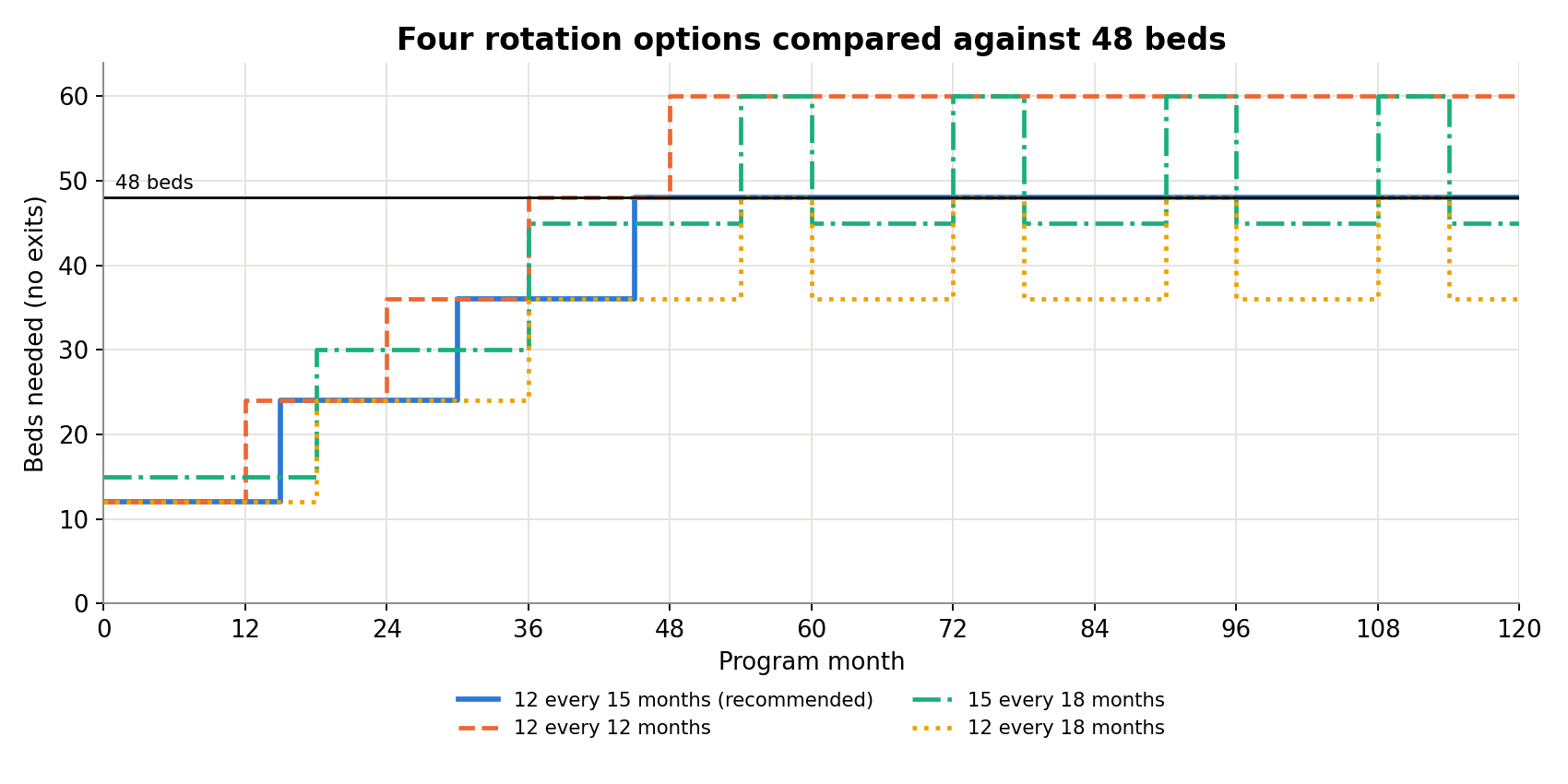
Beds used over time (no early exits)
| Month | 12 every 15 (recommended) | 12 every 12 | 15 every 18 | 12 every 18 |
|---|---|---|---|---|
| 0 | 12 | 12 | 15 | 12 |
| 12 | 12 | 24 | 15 | 12 |
| 15 | 24 | 24 | 15 | 12 |
| 24 | 24 | 36 | 30 | 24 |
| 30 | 36 | 36 | 30 | 24 |
| 36 | 36 | 48 | 45 | 36 |
| 45 | 48 | 48 | 45 | 36 |
| 48 | 48 | 60 | 45 | 36 |
| 54 | 48 | 60 | 60 | 48 |
| 60 | 48 | 60 | 45 | 36 |
| 72 | 48 | 60 | 60 | 48 |
| 84 | 48 | 60 | 45 | 36 |
| 96 | 48 | 60 | 45 | 36 |
| 108 | 48 | 60 | 60 | 48 |
| 120 | 48 | 60 | 45 | 36 |
Bold numbers are over the 48-bed limit.
The honest cost of the recommended plan
The recommended plan ramps up slowly. Beds are 12, then 24, then 36, and the unit is not full until month 45. Across the first five years that is 1,080 "empty bed-months" (one bed empty for one month counts as one). The 12-every-18 plan leaves more empty (1,296). The plans that fill faster (12 every 12, 15 every 15) do so only by running out of beds later.
Leadership should decide what the unused beds do during the ramp-up. They can be held for TJP, used by the institution for general housing until each cohort starts, or used for a small orientation waitlist group. This is a leadership call, not a resident call.
3. The Rotation at a Glance
The five-year journey of one resident
Every resident follows the same 20-quarter path. A quarter is 13 weeks: 10 course weeks plus 3 flex weeks.
| Journey quarter | Months into journey | Phase | What happens |
|---|---|---|---|
| 1 | 0 to 2 | Orientation | Personal Narrative, consent, baseline measures, TRUST charter, Meeting Rhythm, Playbook, mentor match |
| 2 to 14 | 3 to 41 | Student Phase | 13 courses, one per quarter |
| 15 to 16 | 42 to 47 | Facilitator Phase | Co-facilitate Peer-led sessions, Channel 4 teaching, Keystone team forms (quarter 16) |
| 17 | 48 to 50 | Keystone | 10-week Keystone, external panel in week 10 |
| 18 to 20 | 51 to 59 | Facilitator Phase | Co-facilitate, mentor, Keystone follow-up, 6-month Adoption Register check, graduation letter |
A useful side effect: the Keystone ends at about month 50, so the 6-month Adoption Register check happens around month 57, while the team is still in the unit. The team gets to see whether anything outside the fence moved before they graduate.
Gantt chart: all cohorts, 10 years
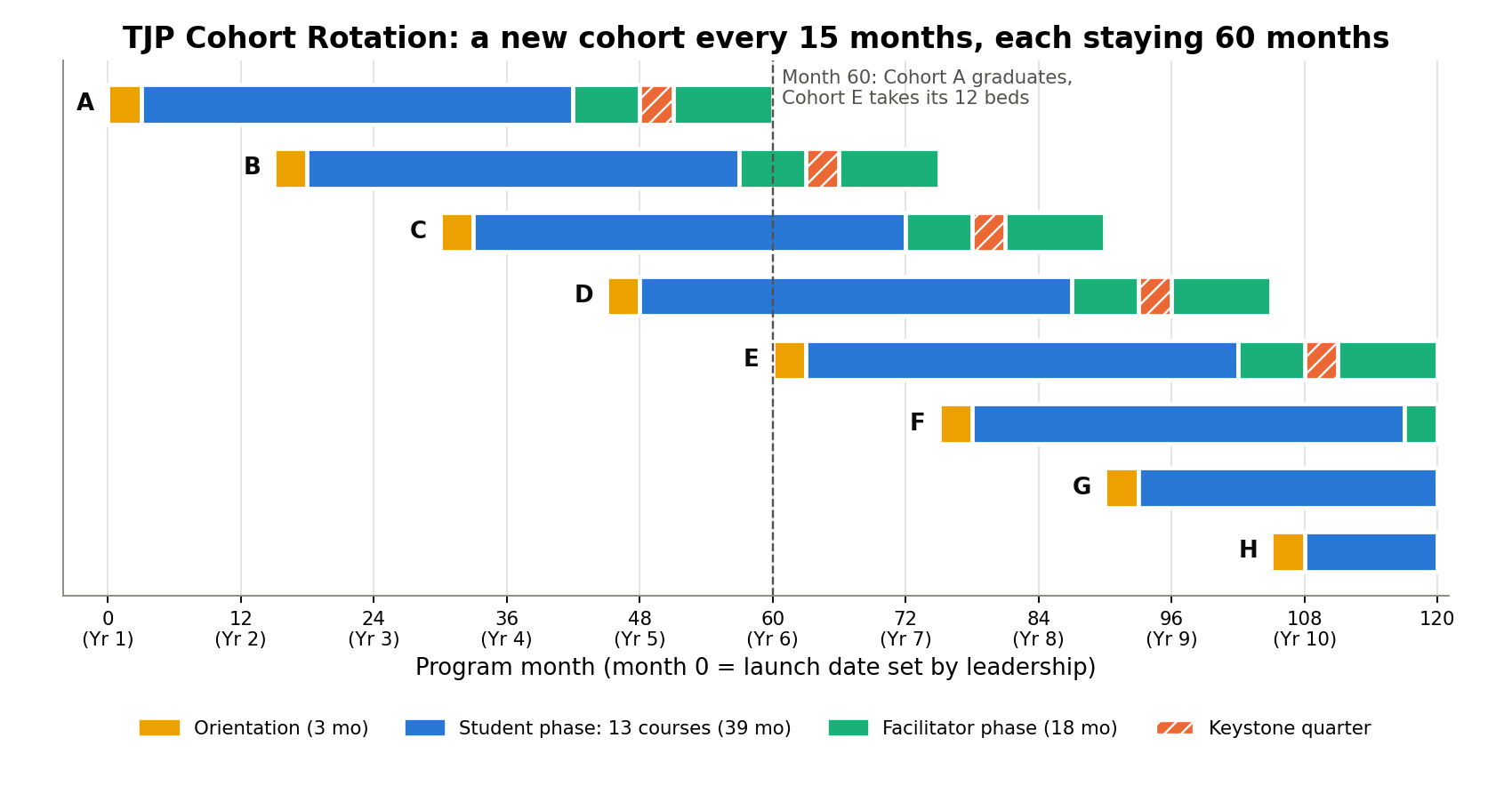
The same Gantt chart as a table
| Cohort | Orientation (months) | Student Phase (months) | Facilitator Phase, with Keystone (months) | Graduates |
|---|---|---|---|---|
| A (pilot) | 0 to 2 | 3 to 41 | 42 to 59 (Keystone 48 to 50) | Month 60 |
| B | 15 to 17 | 18 to 56 | 57 to 74 (Keystone 63 to 65) | Month 75 |
| C | 30 to 32 | 33 to 71 | 72 to 89 (Keystone 78 to 80) | Month 90 |
| D | 45 to 47 | 48 to 86 | 87 to 104 (Keystone 93 to 95) | Month 105 |
| E | 60 to 62 | 63 to 101 | 102 to 119 (Keystone 108 to 110) | Month 120 |
| F | 75 to 77 | 78 to 116 | 117 to 134 (Keystone 123 to 125) | Month 135 |
Notice the pattern: each new cohort after D moves into the beds of the cohort that just graduated. E takes A's beds at month 60. F takes B's beds at month 75. The rotation never needs a 49th bed.
Bed occupancy by phase
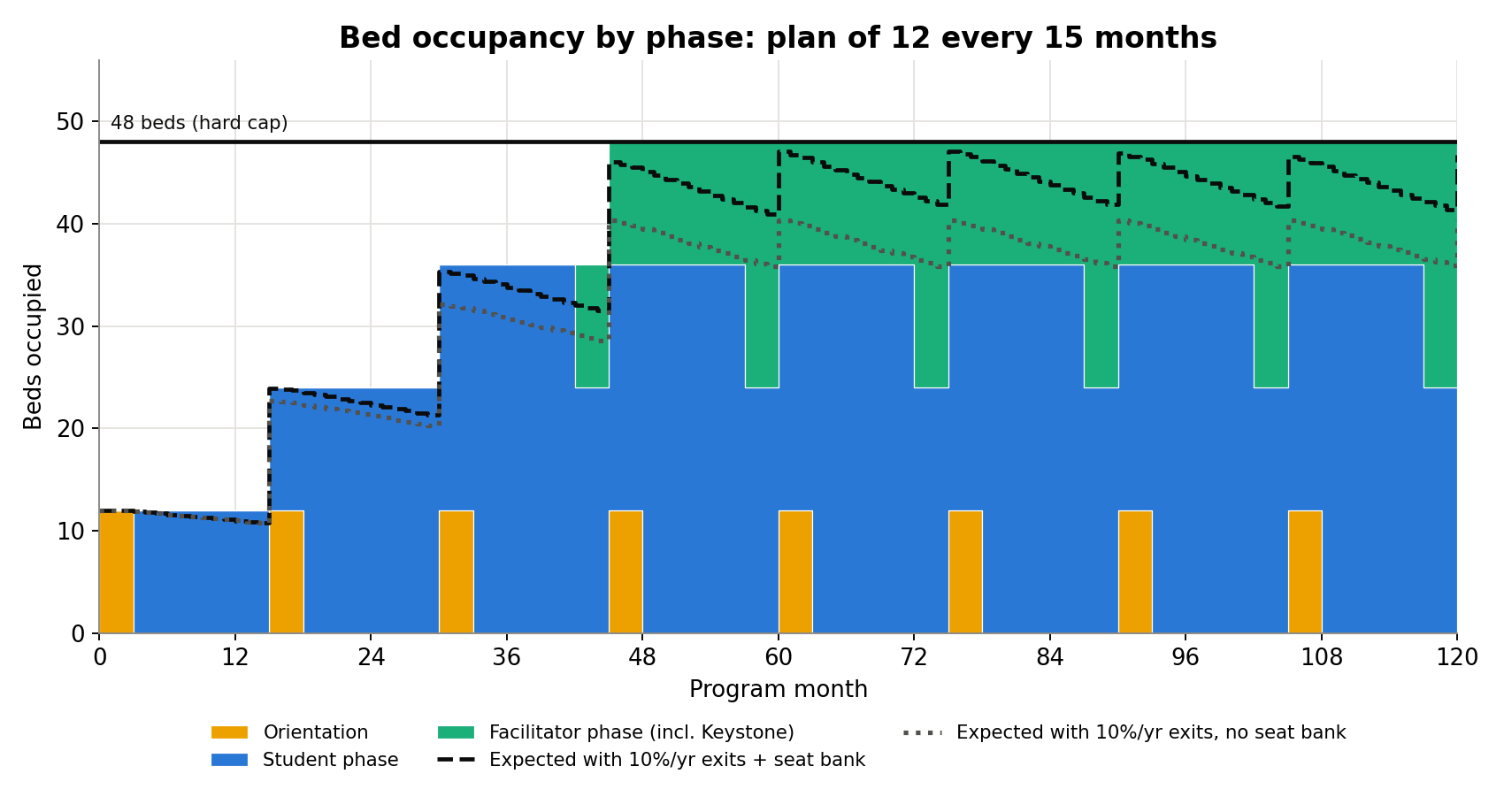
| Month | Orientation | Student Phase | Facilitator Phase | Total beds |
|---|---|---|---|---|
| 0 | 12 (A) | 0 | 0 | 12 |
| 15 | 12 (B) | 12 (A) | 0 | 24 |
| 30 | 12 (C) | 24 (A, B) | 0 | 36 |
| 45 | 12 (D) | 24 (B, C) | 12 (A) | 48 |
| 57 | 0 | 24 (C, D) | 24 (A, B) | 48 |
| 60 | 12 (E) | 24 (C, D) | 12 (B) | 48 |
4. Attrition: Planning for People Who Leave Early
Why people leave
Not every resident who starts will finish 60 months in the unit. Four kinds of exit are realistic:
- Release. A parole grant, sentence change, or other lawful release. This is often good news, and TJP should celebrate it, not count it as failure.
- Transfer. Security classification, medical need, or institutional decisions.
- Removal. Serious rule violations under SCDC policy or a TJP integrity breach.
- Voluntary exit. A resident decides the program is not for him.
We do not know TJP's real exit rate yet. Nobody does. Verify locally: ask SCDC for the typical yearly rate of release and transfer among residents who match TJP intake criteria. Until then, we modeled four rates: 5%, 10%, 15%, and 20% of residents leaving per year.
What happens with no rule at all
If nobody is ever replaced, a cohort of 12 shrinks steadily. At 10% per year, about 7 of 12 would still be in the unit at graduation, and about 8 would be there at the Keystone. At 20% per year, only about 4 would graduate. Beds sit empty and the rotation looks weaker than it is.
The recommended rule: backfill early, bank the rest
Rule 1: Backfill only during the Orientation Quarter. If a resident leaves during his cohort's first quarter, the next screened person on the waitlist takes the seat and joins that same cohort. He catches up on the Personal Narrative with his mentor. Nobody joins a cohort after the first course starts, because every course builds trust in the room, and a stranger arriving in week 6 of Course 11 changes the room for everyone.
Rule 2: After Orientation, the seat goes into the seat bank. The bed stays empty until the next cohort starts. Then the next cohort is enlarged by the number of banked seats, up to 3 extra, so no cohort is larger than 15. This keeps groups inside TJP leadership's 12 to 15 range.
Rule 3: Never exceed 48. The next cohort's size is always the smaller of (12 + banked seats, maximum 15) and (48 minus beds occupied on start day).
Rule 4: Keep a screened waitlist of about 6. Half a cohort. These are people who have already passed screening, so a backfill can happen in days, not months.
What the model shows
We ran each exit rate 3,000 times with random exits, in Python, over 120 months.
| Yearly exit rate | Average beds filled, years 6 to 10, with seat bank | Same, no seat bank | Graduates by month 120, with bank / without | Cohort A residents still in at Keystone (average) |
|---|---|---|---|---|
| 5% | 46.3 | 42.8 | 50 / 47 | 9.8 of 12 |
| 10% | 44.3 | 38.1 | 41 / 36 | 8.0 of 12 |
| 15% | 41.5 | 34.0 | 32 / 28 | 6.5 of 12 |
| 20% | 37.7 | 30.3 | 25 / 21 | 5.1 of 12 |
In every case the bank rule never pushed the unit over 48. At a 10% exit rate, cohorts after A averaged about 13 to 15 residents, which is inside the target range.
What this means for planning
- Plan for 12, expect 13 to 15 in later cohorts. Buy books and supplies for 15 per cohort.
- Expect Keystone teams to be smaller than the starting cohort. At a 10% exit rate, about 8 residents from a cohort of 12 reach the Keystone, which makes 2 teams of 4. At 20%, it may be 1 team of 5.
- Report exits honestly in the TJP Monthly Report, sorted into the four kinds above. A release is not a program failure, and the report should say so.
- Intake criteria are the biggest lever on attrition. Choosing residents whose time remaining matches the 5-year journey reduces release exits more than any backfill rule.
5. Cohort A Is the Pilot
Cohort A carries a heavier load than any cohort after it. It has no senior cohort to learn from. Every Peer-led session in its student phase has to be run by staff, because no certified peer facilitators exist yet. It will test every worksheet, every schedule, and every rule in this document.
That is why we recommend:
- Start Cohort A at 12, not 15. Small enough to learn from, big enough to form 2 or 3 Keystone teams later.
- Use the 15-month gap before Cohort B on purpose. In those 15 months, Cohort A finishes Orientation and 4 courses (11, 9, 1, 3) and starts Course 13, No One Educates Alone. That is 5 Horizon Reviews of learning before Cohort B arrives.
- Allow one change per course and one big change per cohort (Section 11). No redesigning the whole program after a bad week.
- Hold Cohort B's size at 12 even if seats are banked, unless the Interdepartmental Committee decides otherwise. The seat bank starts with Cohort C. This keeps the second learning cycle small too. (The attrition model in Section 4 released banked seats starting with Cohort B, so holding B at 12 lowers bed use by a seat or two in years 2 to 4.)
- Ask the Board of Volunteers to observe at least one session per course during Cohort A's student phase, as guardians of program integrity.
6. The Recommended Course Order
The curriculum is modular. Any course can stand alone. But a rotation needs one fixed order so every cohort takes the same course in the same journey quarter. That fixed order is what makes the teaching ladder (Section 8) possible.
| Journey quarter | Course | Why it sits here |
|---|---|---|
| 2 | 11 Acts of Violence Are Failed Requests | Lowest clinical risk, fastest visible result. Skills usable in the dayroom the same week. Builds the language of the whole unit. |
| 3 | 9 Identity Is a Vote | Least clinically sensitive course. Gives every resident a working habit system for the next 4 years. |
| 4 | 1 Constructing a Changed Mind | Supplies the shared vocabulary (window of tolerance, integration) that every later course borrows. |
| 5 | 3 The Science of Safety | Teaches regulation and co-regulation before any trauma content arrives. Safety before depth. |
| 6 | 13 No One Educates Alone | Facilitator certification. Placed fifth so each cohort finishes it at month 17 of its journey, just as the next cohort starts its first course. |
| 7 | 7 The Attention You Own | Daily practice that residents can use to steady themselves through the harder year ahead. |
| 8 | 10 Redemptive Compassion | Empathy and repair, which prepare the ground for the clinical block. |
| 9 | 2 The Unmaking of a Criminal | Social history and restorative framing. Heavier material, placed after regulation and compassion skills are in place. |
| 10 | 4 Trauma and the Brain | Start of the clinical block. Licensed mental health professional required in weeks 1 to 6. |
| 11 | 5 The Unfinished Response | Somatic practice right after trauma education, so the body work follows the understanding. Trauma-trained facilitator in weeks 5 and 6. |
| 12 | 6 The Engine of Violence | Shame and violence. Licensed professional in week 6. |
| 13 | 8 Ask a Different Question | Addiction. Licensed professional in weeks 5 and 6. Closes the clinical block. |
| 14 | 12 Leverage Points | Systems thinking last, because it feeds directly into the Keystone (leverage justification, theory of change). |
A hidden benefit: one clinical block at a time
Because cohorts start 5 quarters apart and the clinical block (Courses 4, 5, 6, 8) lasts 4 quarters, no two cohorts are ever in the clinical block at the same time. Cohort A's clinical block is quarters 10 to 13, Cohort B's is 15 to 18, Cohort C's is 20 to 23. Licensed staff serve one cohort at a time, never two. That is the single most important staffing protection in this plan.
The hold rule for clinical courses
If a licensed mental health professional is not confirmed one full quarter before Course 4 is due, do not run Course 4 without one. Instead, swap in Course 12 Leverage Points early, and push the clinical block back one quarter. The Interdepartmental Committee makes this call. A swap is a small delay. Running trauma content without clinical support is the fastest way to cause harm and lose the whole program.
7. The Course-by-Quarter Schedule
Once the order is fixed and cohorts start 5 quarters apart, the whole schedule falls out automatically.
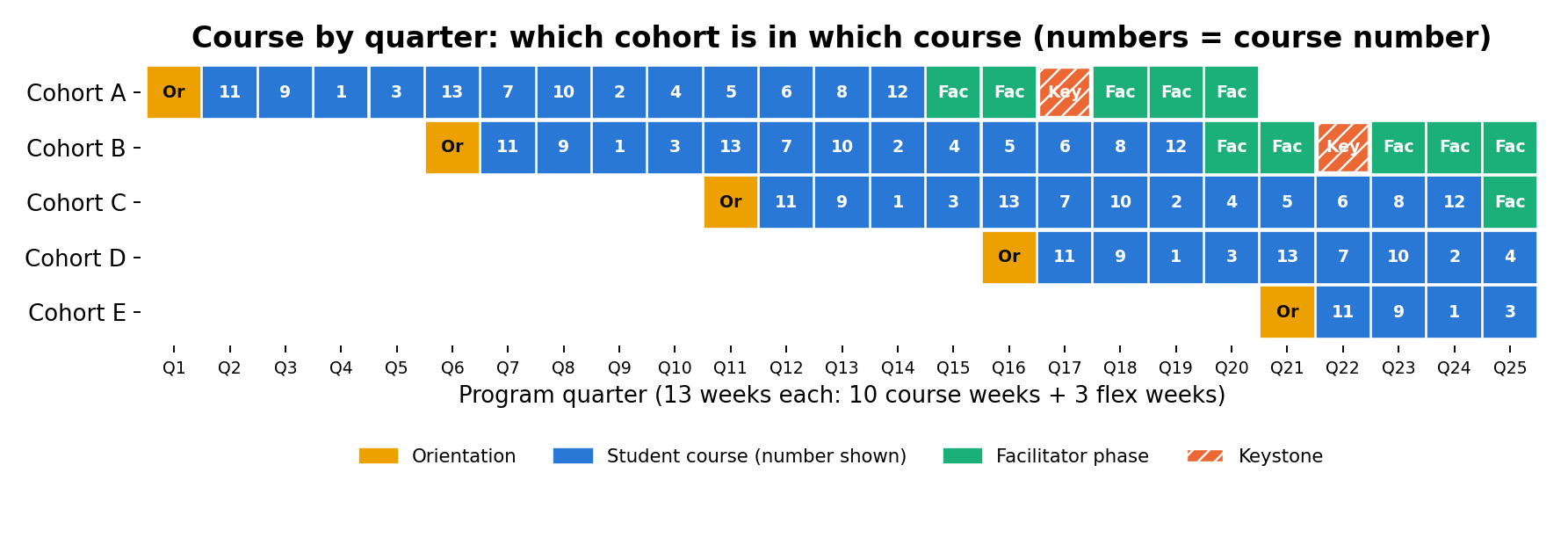
How many courses run at once?
At most 3 courses run in the same quarter, one for each cohort in the student phase. At steady state (from quarter 16 on), the pattern repeats every 5 quarters:
- 2 quarters with 3 courses running (plus a Keystone or Orientation in one of them),
- 3 quarters with 2 courses running (plus an Orientation, or a Keystone, or neither).
Only one cohort is ever in Orientation at a time, and only one is ever in the Keystone at a time.
The schedule as a table (quarters 1 to 25)
Quarter 1 begins at month 0. Each quarter is 13 weeks.
| Qtr | Months | Who is in what | Senior peers co-facilitating | Courses running |
|---|---|---|---|---|
| 1 | 0 to 2 | A: Orientation | None yet (staff only) | 0 |
| 2 | 3 to 5 | A: Course 11 | None yet | 1 |
| 3 | 6 to 8 | A: Course 9 | None yet | 1 |
| 4 | 9 to 11 | A: Course 1 | None yet | 1 |
| 5 | 12 to 14 | A: Course 3 | None yet | 1 |
| 6 | 15 to 17 | A: Course 13; B: Orientation | A certifies at end of quarter | 1 |
| 7 | 18 to 20 | A: Course 7; B: Course 11 | A for B | 2 |
| 8 | 21 to 23 | A: Course 10; B: Course 9 | A for B | 2 |
| 9 | 24 to 26 | A: Course 2; B: Course 1 | A for B | 2 |
| 10 | 27 to 29 | A: Course 4; B: Course 3 | A for B | 2 |
| 11 | 30 to 32 | A: Course 5; B: Course 13; C: Orientation | A for B; A mentors C | 2 |
| 12 | 33 to 35 | A: Course 6; B: Course 7; C: Course 11 | A for B; B for C | 3 |
| 13 | 36 to 38 | A: Course 8; B: Course 10; C: Course 9 | A for B; B for C | 3 |
| 14 | 39 to 41 | A: Course 12; B: Course 2; C: Course 1 | A for B; B for C | 3 |
| 15 | 42 to 44 | A: Facilitator; B: Course 4; C: Course 3 | A for B; B for C | 2 |
| 16 | 45 to 47 | A: Facilitator (teams form); B: Course 5; C: Course 13; D: Orientation | A for B and C; A mentors D | 2 |
| 17 | 48 to 50 | A: Keystone; B: Course 6; C: Course 7; D: Course 11 | B for C; C for D; A coaches | 3 |
| 18 | 51 to 53 | A: Facilitator; B: Course 8; C: Course 10; D: Course 9 | A, B for C; C for D | 3 |
| 19 | 54 to 56 | A: Facilitator; B: Course 12; C: Course 2; D: Course 1 | A, B for C; C for D | 3 |
| 20 | 57 to 59 | A and B: Facilitator; C: Course 4; D: Course 3 | A, B for C; C for D | 2 |
| 21 | 60 to 62 | A graduates. B: Facilitator; C: Course 5; D: Course 13; E: Orientation | B for C and D; B mentors E | 2 |
| 22 | 63 to 65 | B: Keystone; C: Course 6; D: Course 7; E: Course 11 | C for D; D for E; B coaches | 3 |
| 23 | 66 to 68 | B: Facilitator; C: Course 8; D: Course 10; E: Course 9 | B, C for D; D for E | 3 |
| 24 | 69 to 71 | B: Facilitator; C: Course 12; D: Course 2; E: Course 1 | B, C for D; D for E | 3 |
| 25 | 72 to 74 | B and C: Facilitator; D: Course 4; E: Course 3 | B, C for D; D for E | 2 |
From quarter 21 on, the pattern repeats every 5 quarters with the letters shifted by one. Quarter 26 looks like quarter 21 with C in B's place, D in C's place, and so on.
Inside each quarter
| Weeks | What happens |
|---|---|
| 1 to 10 | The course. One 90-minute session per week. Weeks 1 to 6 in the Think Tank, 7 to 9 in the Task Force, week 10 deliver and publish. Baseline measures in week 1, post measures in week 10. |
| 11 | Horizon Review (half day) for every cohort. 3 Ws debrief. One change chosen. Make-up measures. |
| 12 to 13 | Flex weeks. Make up sessions lost to lockdowns or holidays. Product library filing. Facilitator prep for next quarter. If nothing was lost, residents use these weeks for independent study and Channel 4 preparation. |
8. The Teaching Ladder: Each One Teach One
How the ladder works
Because every cohort takes the courses in the same order, and cohorts are 5 quarters apart, the cohort just ahead has always completed the exact course the junior cohort is taking. Cohort A finished Course 11 in quarter 2. Cohort B takes Course 11 in quarter 7. By then, A has also finished Course 13 (facilitator certification) in quarter 6.
That is the ladder:
- Cohort A is taught by staff only. No certified peers exist yet.
- Cohort B is taught by staff in Staff-led sessions and by certified Cohort A residents in Peer-led sessions.
- Cohort C is taught by staff and by certified Cohort B residents, with Cohort A residents coaching the new B facilitators ("coach the coach").
- Cohort D gets C as co-facilitators with B coaching, and so on.
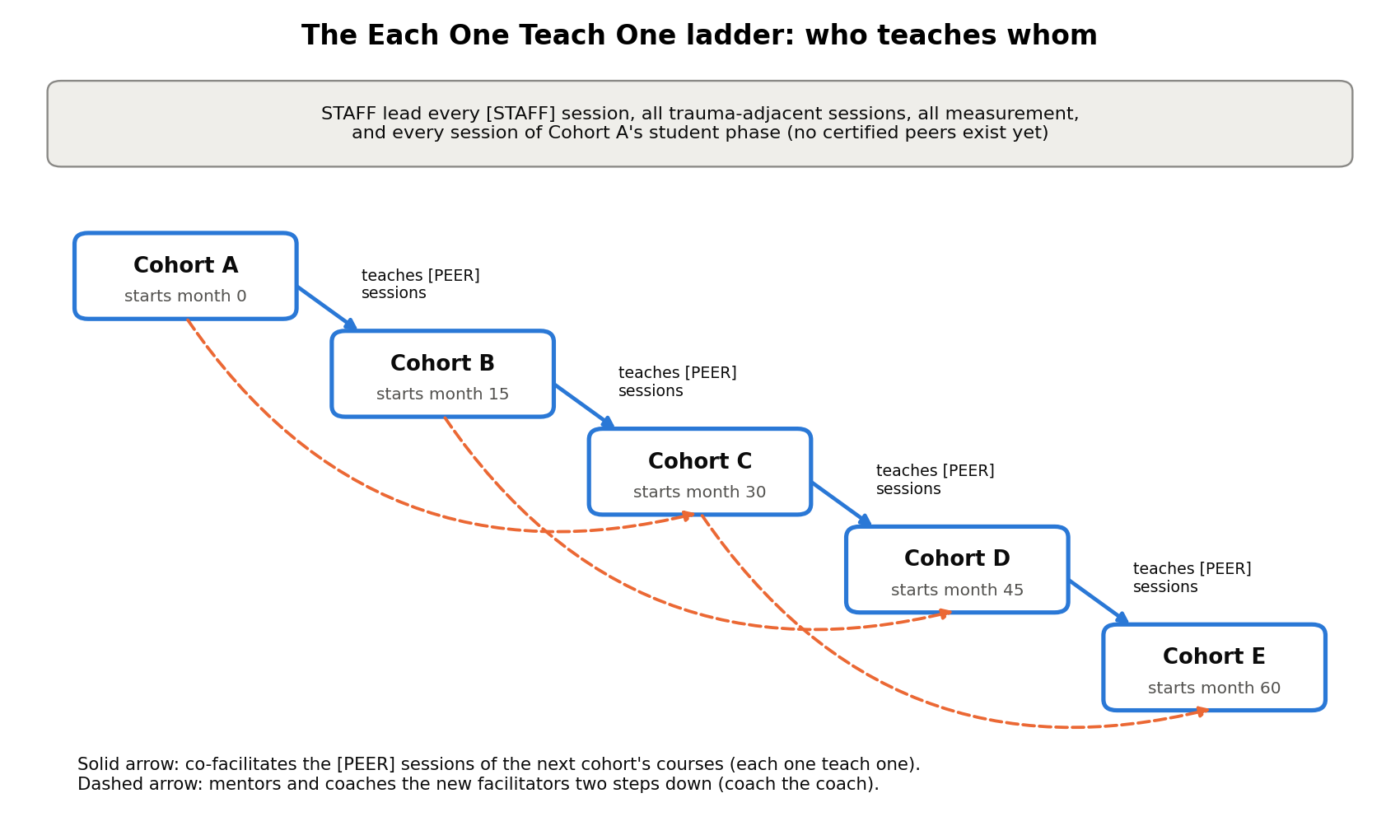 Staff-led sessions. Each cohort co-facilitates the Peer-led sessions of the next cohort, and coaches the facilitators of the cohort two steps down.">
The ladder as a table
| Cohort | Taught in Staff-led sessions by | Co-facilitated in Peer-led sessions by | Coached by | Later teaches |
|---|---|---|---|---|
| A | Staff | Staff (no peers yet) | Staff and Board of Volunteers observers | B (and coaches C) |
| B | Staff | Certified A residents | Staff | C (and coaches D) |
| C | Staff | Certified B residents, A in Facilitator Phase | A | D (and coaches E) |
| D | Staff | Certified C residents, B in Facilitator Phase | B | E (and coaches F) |
| E | Staff | Certified D residents, C in Facilitator Phase | C | F (and coaches G) |
Two levels of peer facilitator
- Apprentice co-facilitator (during the student phase, after Course 13 certification). Always in pairs. No more than one Peer-led session per resident per quarter, so his own studies come first.
- Lead peer co-facilitator (during the Facilitator Phase). Leads Peer-led sessions with a partner, coaches apprentices, delivers Channel 4 training to other units, and helps run Orientation for new cohorts.
Rules that never bend
- Peer facilitators lead only Peer-led sessions. Staff lead every Staff-led session. No exceptions for short staffing. If a staff facilitator is absent, the Staff-led session moves into a flex week. It is never handed to a peer.
- Peer facilitators are educators, never therapists. When a resident discloses distress, the peer's only job is to make the referral and stay present.
- All measurement is administered by qualified staff, never by peers.
- Certification follows the Master Curriculum standard: complete Course 13, deliver both required sessions at rubric standard, and co-facilitate once under staff observation. Cohort A's observed co-facilitation happens in quarter 7, in Cohort B's Course 11.
- Staff presence and observation of peer-led sessions follows SCDC and institutional policy, set by the Interdepartmental Committee.
9. Staff Facilitation Load per Quarter
Staff leadership is not optional in TJP. Residents do the work; the three levels of leadership govern it. So the question is not "can peers replace staff?" but "how much staff time does the rotation need, and when?"
We counted every staff-led and peer-led session using the current Staff-led and Peer-led tags in the course packets, plus these assumptions (adjust locally):
- Cohort A's student courses: all 10 sessions staff-led (no certified peers yet).
- Orientation: 10 staff-led sessions for Cohort A; for later cohorts, 6 staff-led and 4 peer-led.
- Keystone: 4 staff-led sessions (weeks 1, 2, 3, 9) and 6 team-led sessions.
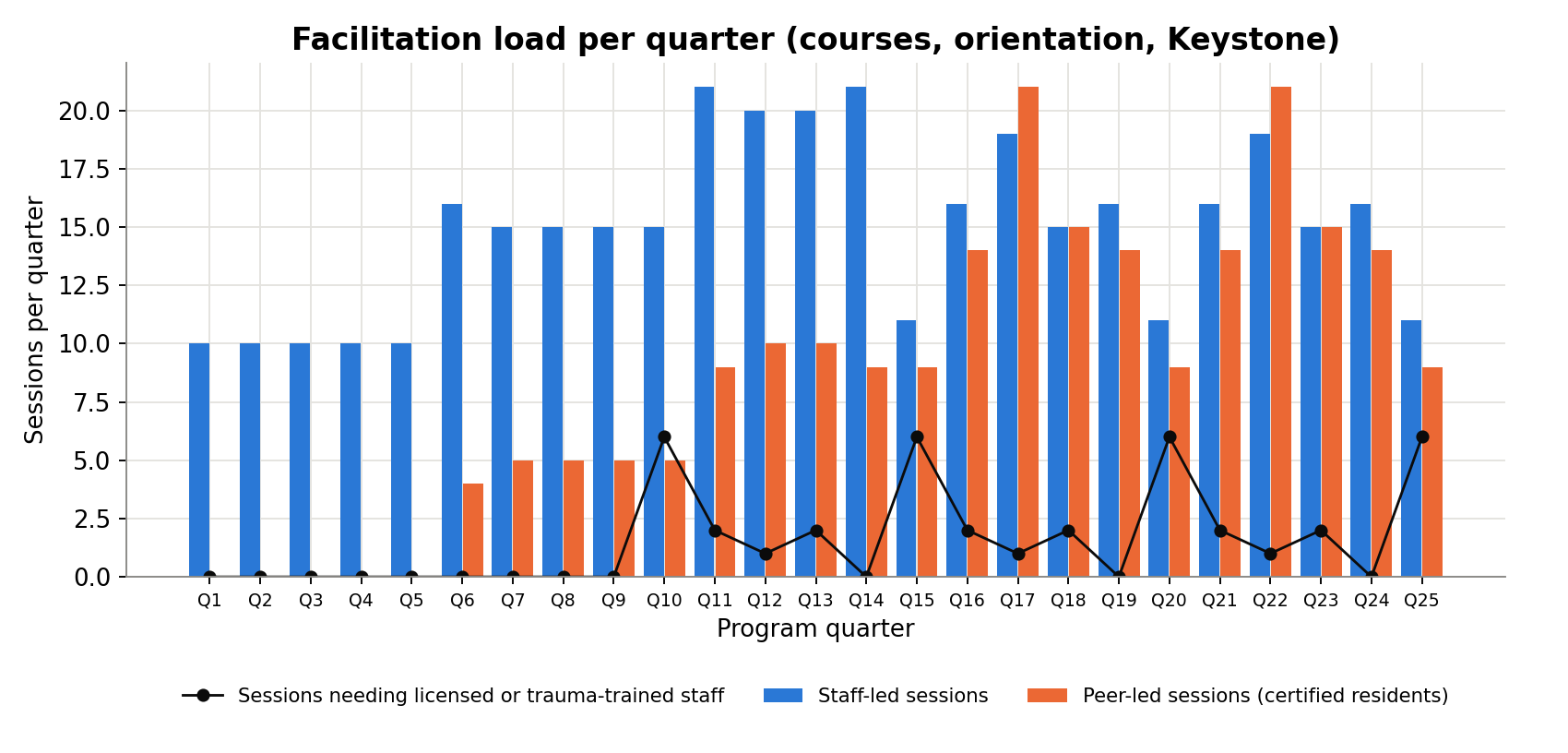
| Qtr | Staff-led sessions | Peer-led sessions | Sessions needing licensed or trauma-trained staff | Note |
|---|---|---|---|---|
| 1 to 5 | 10 each | 0 | 0 | Cohort A only |
| 6 | 16 | 4 | 0 | A in Course 13, B Orientation |
| 7 to 9 | 15 each | 5 each | 0 | Two courses running |
| 10 | 15 | 5 | 6 | A in Course 4 |
| 11 | 21 | 9 | 2 | Peak staff quarter |
| 12 | 20 | 10 | 1 | |
| 13 | 20 | 10 | 2 | |
| 14 | 21 | 9 | 0 | Peak staff quarter |
| 15 | 11 | 9 | 6 | B in Course 4 |
| 16 | 16 | 14 | 2 | D Orientation |
| 17 | 19 | 21 | 1 | A Keystone |
| 18 | 15 | 15 | 2 | |
| 19 | 16 | 14 | 0 | |
| 20 | 11 | 9 | 6 | C in Course 4 |
| 21 to 25 | 16, 19, 15, 16, 11 | 14, 21, 15, 14, 9 | 2, 1, 2, 0, 6 | Steady pattern repeats every 5 quarters |
What this means in plain numbers
- Peak staff load is 21 sessions in a quarter, which is about 2 staff-led 90-minute sessions per week across 10 course weeks. It happens in quarters 11 and 14, while Cohort A is still being taught entirely by staff.
- At steady state, staff lead 11 to 19 sessions per quarter, about 1 to 2 sessions a week, because certified peers carry the Peer-led half.
- Licensed or trauma-trained staff are needed for 0 to 6 sessions per quarter, and never for two cohorts at once. The heaviest quarter for clinical staff is whenever a cohort is in Course 4 (6 sessions).
- Session time is not the only staff time. Add preparation, observation of peer sessions, measurement, the Meeting Rhythm, and the TJP Monthly Report. Verify locally how many staff hours per week the Programs Supervisor can assign.
10. Orientation Design
Length
TJP leadership suggested 4 to 6 weeks. We recommend a 6-week core orientation inside a full Orientation Quarter:
- Weeks 1 to 6: Core Orientation. Structured sessions (below).
- Weeks 7 to 10: Narrative and Mentoring Block. Residents finish the Personal Narrative with support, shadow a senior resident, and sit in on one Tactical meeting.
- Week 11: Orientation Horizon Review.
- Weeks 12 to 13: Flex. Backfill arrivals catch up here.
This keeps Orientation lined up with the quarter grid, so the new cohort starts Course 11 in the same week every other cohort starts its next course.
The six core weeks
| Week | Focus | What happens | Led by |
|---|---|---|---|
| 1 | Welcome and consent | Vision and mission. Program rules. Informed consent for measurement (separate from participation). Baseline instruments. Confidentiality limits explained in writing. | Staff |
| 2 | TRUST charter | The cohort writes and signs its TRUST charter: Tell it early, Rank the idea not the person, Unfinished is allowed, Say it in the room, Take the task. | Staff, with senior peer |
| 3 | The TJP Meeting Rhythm | Practice Check-In, Tactical, Strategic, and Horizon Review. Every resident runs one Check-In. | Senior peer, staff present |
| 4 | The TJP Playbook | Walk the Eight Questions. The cohort writes its first answers to Q6 (One Big Thing) and Q7 (who does what). | Senior peer, staff present |
| 5 | The Personal Narrative begins | Prompts introduced with care. Referral path stated. Writing supports for every reading level. | Staff |
| 6 | Mentor match and ADOPT preview | Each new resident is matched with a senior resident. First small ADOPT exercise (Four Cuts) on a unit problem. | Staff and senior peers |
The mentor match
Each new resident is paired with one senior resident from the cohort in the Facilitator Phase (for Cohort E, that is Cohort B), with the next cohort up as backup. Pairs meet 30 minutes a week for the first two quarters. Mentors are guides and examples, not counselors. They follow the same scope rule as peer facilitators.
Reading levels
Every orientation handout is written in plain language, read aloud in session, and available in large print. Residents who read below a set level get a reading partner and extra time. Reading level is never a reason to exclude someone. TJP's mission depends on reaching people wherever they start.
Selection and intake criteria to consider
Leadership sets the final criteria with SCDC. The Interdepartmental Committee drafts; the SCDC Division of Programs, Reentry, and Rehabilitative Services approves; the Board of Volunteers reviews for fairness and integrity. The criteria below are a starting list, not a decision.
| Area | Suggested starting point | Why it matters |
|---|---|---|
| Time remaining | At least 60 months to projected release at cohort start, so the resident can finish the full journey. Leadership may consider shorter time for strong candidates, with a written plan. | Reduces release exits, the biggest source of attrition |
| Disciplinary history window | No major infractions in a set window before application (for example 12 to 24 months), per SCDC policy | Protects the room and the program's standing |
| Commitment | Written application, interview, signed commitment to the 5-year journey and TRUST | People who choose it tend to stay |
| Mental health readiness | Clearance from mental health staff, especially for clinical courses | Safety for the resident and the group |
| Housing and custody | Eligible for the TJP housing under SCDC classification rules | Only SCDC can decide this |
| Fairness | Clear written criteria, same process for everyone, reasons recorded for every decision | Trust from residents, staff, and the public |
| Mix | Leadership may aim for a mix of ages, backgrounds, and sentence lengths | Richer rooms, stronger products |
11. Keystone Timing
When teams form
- Journey quarter 15 (month 42): the cohort enters the Facilitator Phase. Residents start noticing harms and partners that could become Keystone topics.
- Journey quarter 16 (month 45): teams form, 3 to 5 residents each. Each team picks a candidate harm using ADOPT step A (Four Cuts and Five Whys) and writes a draft PROOF line. The Interdepartmental Committee approves topics.
- Journey quarter 17 (month 48): the 10-week Keystone runs.
- Journey quarters 18 to 20: revisions, adoption outreach, and the 6-month Adoption Register check before graduation.
How many teams at once
Only one cohort is ever in the Keystone at a time, every 15 months. With attrition, a cohort usually reaches the Keystone with 6 to 10 residents, which means 2 or 3 teams. If fewer than 6 remain, form one team of up to 5, or invite the Interdepartmental Committee to approve a mixed team with residents from the next cohort who have finished Course 13, No One Educates Alone.
| Keystone quarter | Program months | Cohort | Expected teams |
|---|---|---|---|
| Q17 | 48 to 50 | A | 2 to 3 |
| Q22 | 63 to 65 | B | 2 to 3 |
| Q27 | 78 to 80 | C | 2 to 3 |
| Q32 | 93 to 95 | D | 2 to 3 |
| Q37 | 108 to 110 | E | 2 to 3 |
Making sure the review panels happen
The Keystone is scored by an external panel on Specificity, Evidentiary Rigor, Deployability, Honesty, and Adoption Potential. Panels are the easiest thing to lose to a scheduling mistake, so:
- Book the panel 9 months ahead, when the cohort enters the Facilitator Phase. The Board of Volunteers leads panel recruitment.
- Set a primary date in week 10 and a backup date in week 12 (a flex week).
- Confirm panelists at the Strategic meeting 3 months out and again in week 6.
- Record panel scores in the TJP Evidence Workbook, and open the team's line in the Adoption Register the same day.
- Because Keystones come every 15 months, one panel roster can serve every Keystone. Invite panelists for a standing commitment.
12. The Learn and Adjust Loop
After every course: a Horizon Review
Each course ends with week 11 of the quarter, which is also when the TJP Meeting Rhythm calls for its quarterly Horizon Review. That is not a coincidence; it is the design. The half-day Horizon Review:
- Revisits Playbook Questions 1 to 4 (why we are here, how we treat each other, what we do, who we do it for).
- Runs a 3 Ws debrief on the course: What Worked, What Wobbled, What's Next.
- Checks the PROOF lines and measurement results.
- Chooses one change for the next time that course runs.
- Files the change on the Cohort Handoff Sheet.
After every Orientation: an Orientation Review
Same format, focused on intake: Who did we choose, and why? Who left in the first quarter, and why? Was the Personal Narrative supported well enough? Did the mentor matches work?
The one change rule, applied to the rotation
- Each course gets one change per run. Not five.
- Each new cohort gets one big change to the rotation itself (for example, lengthening the Narrative block, or changing the mentor meeting schedule). The Interdepartmental Committee approves it.
- A change is kept, adjusted, or dropped after one run, using the ADOPT verdict: ADOPT, ADJUST, or ABANDON.
What Cohort A teaches Cohort B: the handoff
In the quarter Cohort B arrives (quarter 6), Cohort A and staff complete the Cohort Handoff Sheet (Worksheet 4). It is presented at Cohort B's Orientation week 6 and filed in the Playbook. Use the RELAY handoff:
- Record what happened: dates, attendance, exits, measures, products.
- Explain what wobbled: the honest list, blaming the process, not the person.
- List the one change you recommend, with a PROOF line.
- Assign an owner: who carries the change, by when.
- Yield the baton: a senior resident hands the sheet to a junior resident in person, in front of both cohorts.
13. Graduation and What Happens After Year 5
Graduation
At month 60 of its journey, a cohort graduates. Graduation includes:
- A public ceremony with all three levels of leadership invited: the SCDC Division, the Board of Volunteers, and the Interdepartmental Committee.
- Final measures and a 60-month summary in the TJP Evidence Workbook.
- Each resident's product portfolio (13 course products, facilitation record, Keystone package).
- The Next Cohort Letter. The graduating cohort writes one letter to the cohort that will take its beds that same month (A writes to E, B writes to F). It is read aloud in the new cohort's Orientation week 1. It says what the graduates wish they had known.
Bed turnover
The graduating cohort's beds pass directly to the entering cohort. To make the handoff smooth, plan moves in the flex weeks of the last quarter, and have the entering cohort's intake finished one quarter early.
Alumni roles
Graduates are TJP's most valuable asset. Suggested roles, each subject to SCDC approval:
| Situation | Alumni role | What it looks like |
|---|---|---|
| Still in SCDC custody, moved to another unit | TJP Ambassador | Delivers Channel 4 training in the new unit. Carries TJP products. Reports back quarterly. |
| Still in custody, near the TJP unit | Alumni Fellow | Joins Keystone review practice, guest-teaches one Peer-led session per year if approved, helps with Orientation. |
| Released | Alumni Network member | Joins partner reentry programs, speaks at the annual summit, helps with Adoption Register follow-ups, mentors if partners allow. |
| Any | Adoption Register follow-up | Answers the 12, 24, and 36-month adoption check-ins for his Keystone package. |
Leadership should decide early whether a small number of Alumni Fellows can stay housed near the unit. Any bed used for a Fellow is a bed taken from a new cohort, so the default in this plan is no TJP beds for alumni.
14. Governance of the Rotation
TJP is not a resident-led initiative. Residents run the rotation day to day, and it is governed by three levels of leadership.
| Decision | Proposed by | Decided or approved by | Reported in |
|---|---|---|---|
| Intake criteria | Interdepartmental Committee | SCDC Division of Programs, Reentry, and Rehabilitative Services | TJP Monthly Report |
| Cohort start dates and size | Programs Supervisor | Interdepartmental Committee | TJP Monthly Report |
| Seat bank release | Programs Supervisor | Interdepartmental Committee | TJP Monthly Report |
| Course order changes, clinical hold rule | Horizon Review | Interdepartmental Committee | TJP Monthly Report |
| One big change per cohort | Cohort Handoff Sheet | Interdepartmental Committee, with Board of Volunteers review | Playbook, Monthly Report |
| Keystone topics | Keystone teams | Interdepartmental Committee | Playbook |
| Keystone panel recruitment | Board of Volunteers | Board of Volunteers | Monthly Report |
| Program integrity concerns | Anyone | Board of Volunteers, then SCDC Division | Monthly Report |
Every TJP Monthly Report should include one rotation box: beds filled, exits by type, seat bank balance, waitlist size, which courses ran, staff and peer session counts, and the next cohort start date.
15. What Could Go Wrong
| Risk | Warning sign | Response |
|---|---|---|
| Long lockdown | More than 3 course weeks lost in a quarter | Use flex weeks first. If more is lost, slide the whole ladder one quarter together. Never skip a course to catch up. |
| No licensed staff for the clinical block | Not confirmed one quarter before Course 4 | Hold rule: run Course 12 early, move the clinical block back one quarter. |
| High attrition | More than 3 exits in one cohort in a year | Review intake criteria at the next Orientation Review. Use the seat bank. Report honestly. |
| Peer drift into Staff-led sessions | A peer "covering" a staff session | Stop it the same day. Move the session to a flex week. Report to the Interdepartmental Committee. |
| Staff turnover | A key staff facilitator leaves | Keep every course packet complete enough that a new facilitator can run it. Cross-train two staff per course. |
| Cohort too small for Keystone | Fewer than 6 residents left | One team, or a mixed team with approval. |
| Unfair selection | Complaints or patterns in who gets in | Written criteria, recorded reasons, Board of Volunteers review. |
| Transfers breaking cohorts | Residents moved mid-program | Ask SCDC leadership whether program participation can be considered in transfer decisions. Verify locally. |
| Overload on apprentice facilitators | Student work slipping | Cap apprentices at one Peer-led session per quarter. |
16. Why TJP Must Exist
17. Dorm Signage Ideas
Print on letter paper, laminate, and post with the label maker's titles.
A large-format copy of the Course-by-Quarter table (Section 7) should hang in the Task Force room, with a magnet or clip showing "We are here."
Worksheet 1: Cohort Roster and Phase Tracker
Cohort letter: Start month: Planned graduation month:
Starting size: Seats added from seat bank: Backfills during Orientation:
| # | Resident name | Mentor (senior resident) | Current phase and course | Certified peer? (date) |
|---|---|---|---|---|
| 1 | ||||
| 2 | ||||
| 3 | ||||
| 4 | ||||
| 5 | ||||
| 6 | ||||
| 7 | ||||
| 8 | ||||
| 9 | ||||
| 10 | ||||
| 11 | ||||
| 12 | ||||
| 13 | ||||
| 14 | ||||
| 15 |
Phase checklist for the cohort (initial and date):
| Milestone | Target journey quarter | Done (date) | Checked by | Notes |
|---|---|---|---|---|
| Orientation complete, baseline measures in | 1 | |||
| Personal Narratives complete | 1 | |||
| Course 13 finished, certifications recorded | 6 | |||
| First observed co-facilitation | 7 | |||
| Clinical staff confirmed for Course 4 | by 9 | |||
| Student Phase complete (13 courses) | 14 | |||
| Keystone teams formed | 16 | |||
| Keystone panel held | 17 | |||
| 6-month Adoption Register check | 19 | |||
| Next Cohort Letter written | 20 |
Worksheet 2: Quarterly Schedule Grid
Program quarter: Q Program months: to Calendar dates:
Holidays and known closures this quarter:
| Cohort | Phase or course | Staff facilitator(s) | Peer co-facilitators (pairs) | Clinical staff needed? Which weeks? |
|---|---|---|---|---|
Weekly session plan (write course number and Staff-led or Peer-led):
| Week | Session 1 | Session 2 | Session 3 | Room (Think Tank or Task Force) |
|---|---|---|---|---|
| 1 | ||||
| 2 | ||||
| 3 | ||||
| 4 | ||||
| 5 | ||||
| 6 | ||||
| 7 | ||||
| 8 | ||||
| 9 | ||||
| 10 | ||||
| 11 | Horizon Review | |||
| 12 | Flex: | |||
| 13 | Flex: |
Total staff-led sessions: Total peer-led sessions: Sessions lost and made up:
Worksheet 3: Attrition and Backfill Log
Seat bank balance at start of this page: Waitlist size (screened and ready):
| Date | Resident and cohort | Exit type (Release, Transfer, Removal, Voluntary) | Journey quarter at exit | Action (Backfill, Bank, None) |
|---|---|---|---|---|
Backfill details (Orientation Quarter only):
| Date | Seat filled by | From waitlist position | Catch-up plan and mentor | Approved by |
|---|---|---|---|---|
Seat bank release at next cohort start:
Next cohort start month: Beds occupied on start day: Seats available (48 minus occupied):
Next cohort size = 12 + banked seats (max 15), but no more than seats available =
Approved by the Interdepartmental Committee on:
Worksheet 4: Cohort Handoff Sheet (RELAY)
From Cohort: To Cohort: Date:
R: Record what happened
| Item | Number or fact |
|---|---|
| Residents started / still here | |
| Exits by type | |
| Courses completed | |
| Products filed in the library | |
| Residents certified as peer facilitators |
E: Explain what wobbled (blame the process, not the person)
What worked that you must keep:
L: List the ONE change you recommend
Change:
| PROOF line | Fill in |
|---|---|
| Problem Number (baseline) | |
| Result Number (win) | |
| Observer (outside the team) | |
| On this date | |
| Fail Line |
A: Assign an owner Name: By when:
Y: Yield the baton
Handed from (senior resident): To (junior resident):
Witnessed by (staff): Filed in Playbook on:
Interdepartmental Committee decision: ADOPT / ADJUST / ABANDON (circle one)
Further Study
- Donella Meadows, Thinking in Systems: A Primer. The 48 beds are a "stock," and entries and exits are "flows." Meadows explains why a stock changes slowly and why delays fool people into overcorrecting. This is the core idea behind the seat bank and the one change rule, and it ties to Course 12, Leverage Points.
- Patrick Lencioni, Death by Meeting. Source of the four-meeting model behind the TJP Meeting Rhythm, including the quarterly off-site review that TJP calls the Horizon Review.
- Patrick Lencioni, The Advantage. Source of the playbook questions that TJP expanded into the Eight Questions.
- W. Edwards Deming, Out of the Crisis. The case for improving a process in small, measured steps and blaming the system rather than the worker. The roots of the PROOF line and the one change rule.
- Atul Gawande, The Checklist Manifesto. Why simple written checklists (like the worksheets here) prevent errors by skilled people under pressure.
- Paulo Freire, Pedagogy of the Oppressed. The foundation of Course 13 and of the Each One Teach One ladder: people teaching one another, not deposits from an expert.
- TJP Master Curriculum (project document). Session-by-session Staff-led and Peer-led tags, clinical requirements, and the peer facilitator certification standard used in this plan.
- ADOPT Model Task Force Process (project document). The ADOPT steps, TRUST, PROOF, LESS, and 3 Ws used throughout.
Sources
- TJP Master Curriculum (project document): course session tags (Staff-led and Peer-led), clinical presence requirements for Courses 4, 5, 6, and 8, peer facilitator certification standard, and the recommended minimum viable launch (Courses 11 and 9 first).
- ADOPT Model Task Force Process (project document): ADOPT, TRUST, PROOF, LESS, 3 Ws, one change rule.
- TJP leadership, request dated 09-22-2026: cohorts of 12 to 15, 48 beds, 5-year program, start every 12 to 18 months, full 13-course student phase followed by co-facilitation and the Keystone.
- Bed occupancy, attrition, and staff load figures: calculated for this plan in Python (month-by-month model over 120 months; attrition modeled with 3,000 random runs per exit rate). The exit rates of 5%, 10%, 15%, and 20% per year are planning assumptions, not measured SCDC data. Verify locally with SCDC release and transfer data for residents who meet TJP intake criteria.
- Books listed in Further Study are cited for their general ideas only; no statistics are drawn from them.